
When AI saves teachers time, how will they use it?
In this week’s AI Brief, a new Gallup survey finds that most teachers who use AI say it gives them more time for the work that makes them feel they matter, like helping a student through something difficult. Two smaller studies look at a related question: does AI do students’ thinking for them, or help them think?
For school leaders and teachers, this week’s sources ask us to consider how we can use AI to save time that can go back to students, and whether we can encourage students to themselves use AI to support and not replace their thinking.
Let’s get to the sources…
1. “Teachers Using AI Say It Frees Up Time for What Matters Most” | Gallup | Megan Brenan | October 14, 2026
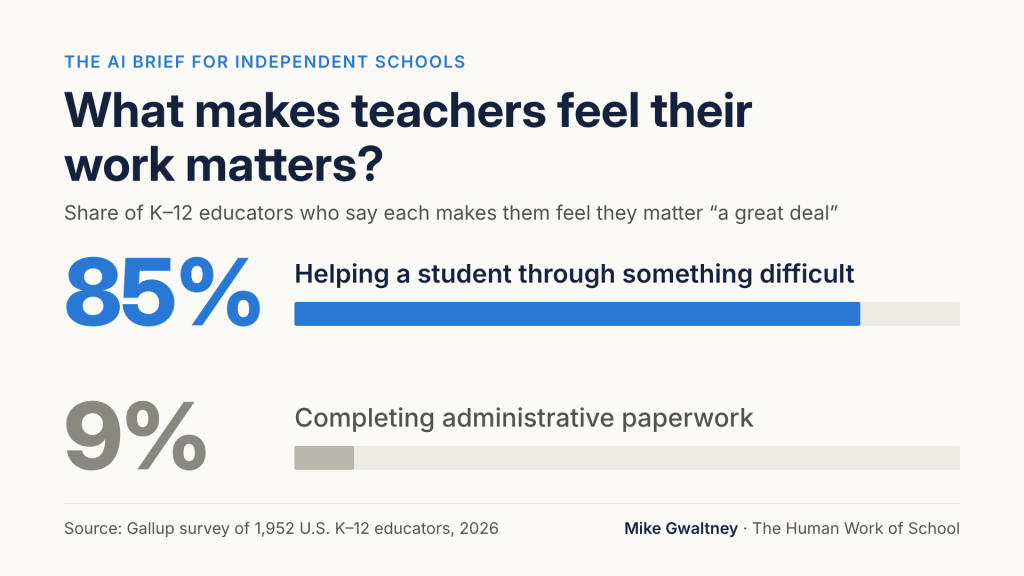
Gallup surveyed nearly 2,000 K-12 educators and found 59% used AI for their work last school year. Of those, nearly two-thirds (64%) said it gave them more time for the work they value most, while 7% said it cost them time. Gallup also asked what makes educators feel their work matters. At the top of the list: helping a student through something difficult (85%), seeing students do well academically (74%), and giving individual feedback (57%). At the bottom: paperwork, at 9%. Disappointingly, only 35% of educators said they feel they matter a great deal at their school. Educators at private, independent and charter schools were more likely to say so than public school educators (44% vs. 32%), though Gallup groups those three types of schools together and notes that differences by school type are small. Noteworthy: educators who feel their school invests in their growth were far less likely to plan to leave within a year: 12%, compared with 41% of those who feel little investment.
Takeaway: The likely best use of AI is to take on the 9% work (paperwork) so teachers can spend more time on the 85% work (helping kids). School leaders have to ensure that the time AI saves doesn’t just become more duties. Here’s a good guiding question for a faculty meeting: “What can you do better for students because AI has changed how you work?” The retention finding in this study matters too. Investing in teachers’ growth, including how they learn to use AI well, is linked to keeping them.

Keep in mind that the survey includes teaching assistants and substitutes as well as teachers, the results are self-reported, and the study was funded by the Walton Family Foundation, a long-time supporter of school choice.
Read the report: https://news.gallup.com/poll/715364/teachers-using-say-frees-time-matters-mostost.aspx
2. “Redesigning Collaborative Teaching for Human–AI Partnership” | Frontiers in Education | Felix Höpfl | Published online September 17, 2026
A university instructor in Germany tested AI in a familiar classroom routine: Think-Pair-Share. When students could use AI during the “think” step, he saw many of them let AI do the thinking. So he made that first step AI-free. Students think on their own, then talk with a partner, and only after that can they use AI. Across several groups of students, 91% agreed with keeping the first step AI-free. His larger point is that instead of simply allowing or banning AI, teachers can decide when in a lesson AI should be available.
Takeaway: This is a practical idea any teacher can try tomorrow, with no new technology. Students do their own thinking first, test it with classmates, and then use AI to challenge or extend their ideas. Academic leaders could use this as an easy starting point for faculty conversations about AI, rather than starting with rules about cheating
Read the study: https://www.frontiersin.org/journals/education/articles/10.3389/feduc.2026.1963902/full
3. “Developing a Generative AI Chatbot to Support Students’ Higher-Order Thinking in STEM Education” | Journal of Microbiology & Biology Education | Richland, et al. | October 14, 2026
Researchers built a math chatbot designed to ask questions rather than give answers. After a short lesson on comparing ratios, 33 fifth and sixth graders used it to explain their solutions and compare different strategies. When the chatbot asked deeper questions, students gave deeper answers.
Takeaway: What matters isn’t only whether students use AI, but what the AI asks them to do. A tool that hands students answers lets them skip the thinking. A tool that asks them to explain their reasoning makes them do more of it. When teachers and academic leaders look at AI tools, a useful test is: does this make students think more, or less? One caution: this is a very small study, it measured students’ conversations rather than whether they learned more math, and the researchers built the tool they studied.
Read the study: https://www.lifescience.net/publications/2253732/developing-a-generative-ai-chatbot-to-support-stud/
Mike Gwaltney is a long-time independent school educator and former Head of School. He is Vice President of Consulting and Learning, and a Senior Consultant at Independent School Management (ISM). Mike has been at the forefront of academic technology since the early 2000s and is widely considered the “OG” of blended and online learning in independent schools. He holds a Master’s in Educational Technology, and writes about student agency, teaching and learning, and leadership and governance of AI in independent schools.


Leave a Reply