
Why flourishing, not finished work, should guide schooling and how students use AI.
As I work with schools in Fall ‘26, I notice most conversations among teachers and leaders still center on one question: “Should students be allowed to use AI?” Some schools have pushed a bit further and narrowed it to “When can students use the tools we choose for them?” Yet students are already using AI on their own, so neither question gets at what matters most.
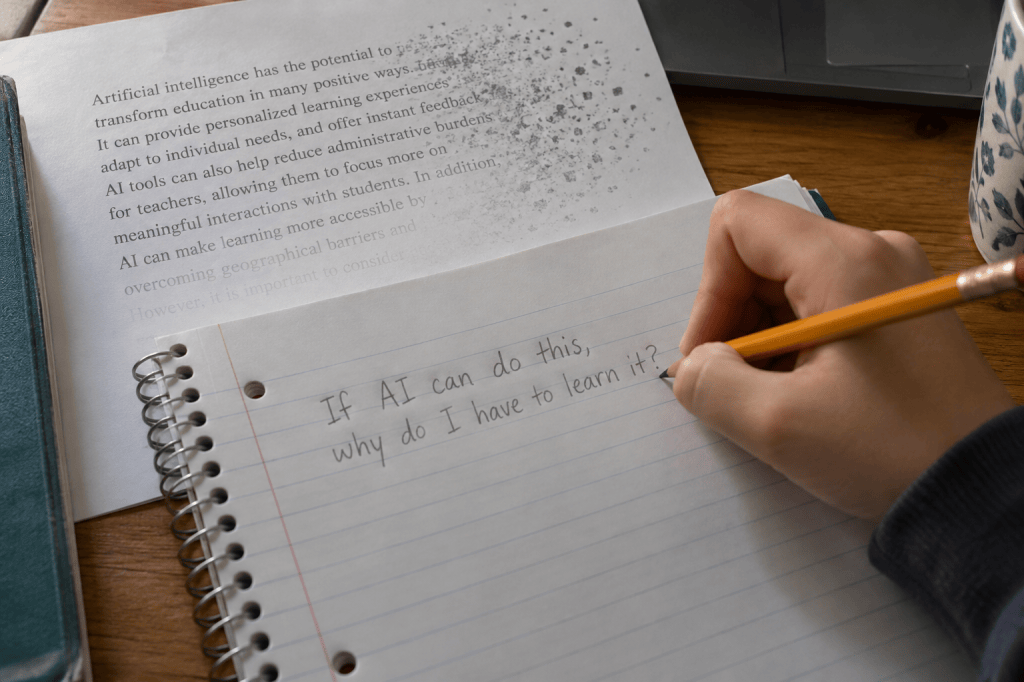
When I talk with students, I hear them asking a different question:
“If AI can do this work, why should I have to learn it?”
You may recognize that question. It isn’t far from the question students have asked their high school teachers for decades: “When will I ever use this in real life?” Schoolwork takes time and energy, and students don’t want to spend either on something that seems irrelevant. Students know AI can already draft essays, solve problem sets, summarize chapters, and propose theses, and they know that it gets better at these tasks every few months. They aren’t wrong to push us toward a more fundamental question.
School leaders and educators should be asking that question too, but in our own form: “When AI can do the thinking, why should students still do it?”
And the question needs a good answer.
My answer begins with the purpose of schooling. I believe schools should be designed to help young people flourish, NOT to be a place where students are assigned and must complete schoolwork as an act of compliance, or a meaningless ritual of childhood. Schooling is intended to have value, and for me that value is real when it prepares students to live a good life in communities and a world that are also thriving.
The goal of school is to prepare young people to live a flourishing life.
So back to the question, why should students still do the work when AI can do it? AI in school must support student development of the capacities they will need to flourish, now and in the future. Yes, obviously AI has inundated modern life already and will be ever more present in students’ futures—they’re correct to remind us of this—so we need good arguments in response to their question. Helping them understand that building the capacities to flourish by doing the work of school is the educator’s contemporary challenge.
First of all, the product was never the point
Every essay, lab report, and proof a student turns in is evidence of something we care about more: what they understand, what they notice, how they reason, and whether they can reach a judgment and defend it.
Writing makes this clearest. In my career as a history, government, and occasional writing instructor, I saw firsthand that writing changes the writer. It forces you to decide what you mean and exposes the weak spot in your argument. Often you find out what you think only by trying to say it. And when AI does that work too early, the “writer” hasn’t just skipped writing the sentences, they’ve skipped the thinking the sentences would have required.
I heard Rebecca Winthrop of Brookings make the stakes plain at a conference I attended earlier this month: when adults hand a skill to a machine, they give away something they already have. Children may never build it in the first place.
Student, you can’t judge what you don’t know
Recently a student told me that when AI does the work and she evaluates it, she’s doing important thinking. That’s fair, evaluation does matter, and it will matter more as AI becomes a bigger part of future life. But no student or citizen can judge a historical claim without knowing history, and they can’t spot a flawed proof just because the steps look tidy. Judgment rests on knowledge, and some of that knowledge has to live in the student, not in a search box. A person who knows a subject sees more. She notices when something doesn’t fit. As I say in workshops for teachers, “you can’t think critically about information you don’t know.”
That leads to a principle I’d urge every school to adopt: the right to delegate intellectual work to AI (or a peer) is earned by becoming capable of understanding and judging the work being delegated. An experienced writer can let AI tighten a paragraph and lose nothing. A ninth grader who lets AI build the argument has lost the very thing the assignment was meant to build. In practice, this means students attempt first and bring in AI second, and the freedom to use AI will differ by age and by subject.
Becoming a good thinker is bigger than being good at academics
Schools tend to define thinking narrowly, as the work of analysis and problem-solving. But because, for me, flourishing is the goal, at least four other kinds of thinking deserve protection.
Imagining and creating. Wonder, curiosity, and the ability to picture something that doesn’t exist yet are essential elements of a flourishing human life. Winthrop cited a study of roughly 370,000 college essays: after ChatGPT arrived, the vocabulary got richer, but the ideas and stories became more alike. A world full of fluent, similar work will quickly become drab. I shudder to think of a world where nothing is original. We need artists, we need creators, we need people who can imagine and wonder.
Knowing yourself honestly. Maybe the oldest maxim in education comes from the ancients: “know thyself.” Students need to tell the difference between understanding something and merely recognizing it because an AI explained it well. That kind of honest self-assessment is where the examined life begins: looking clearly at what you understand, why you choose as you do, and what you truly need and want.
Deciding what you believe and what is right. Some questions are not problems to be solved. Should this historical figure be admired? When does loyalty become complicity? What kind of life do I want to build? AI can offer perspectives and test arguments. But students who learn to hand these questions off grow into adults who are used to receiving judgments they never learned to make, and to taking orders without examining their wisdom. AI’s recommendations will be excellent—or appear so—which is exactly why the habit of acceptance and compliance is so easy to form. No democracy will long stand with citizens who lack judgment.
Thinking with and for other people. Good thinking is rarely a solitary activity. Yes, we’ve been led to believe the way to think best is to isolate, as if at Walden Pond or on a mountainside. But a teacher or peer can push our thinking by asking the question we didn’t ask ourselves. A community asks us to consider obligations our preferences would rather ignore. Others help shape who we become, and we owe something to others in turn. That is the committed life. When a student forms a view, tests it against people who see the world differently, and then takes responsibility for it, they learn something essential for human flourishing. Yes, AI can be one of the voices in that process, but it should not become the only one – it can’t replace the community.
Struggle needs support
None of this works if we simply tell students to struggle on their own. It’s not fair to tell students they should undertake “productive struggle” and watch the struggle become suffering and resignation. Students need support from their teachers. Hard thinking is uncomfortable, and students will only take intellectual risks when they feel they belong and when an adult knows them well enough to push them and to catch them. Growth comes from challenge and support together. Take away the support, and struggle turns into coasting: doing just enough, which AI now makes effortless.
This is where independent schools have a real advantage. Advisory programs, small classes, and teachers who know students across years are exactly the conditions that make demanding human thinking possible. In an AI-shaped world, those relationships become the foundation for everything else.
School leaders: do these 7 things now
Most independent schools now find themselves in an interim period, where they are attempting to sustain the current model of schooling by “managing the challenge of AI.” The coming necessary school transformation doesn’t feel safe yet because there’s just too much to lose by changing what so many people feel invested in, and because families expect the next step, high school or college, to require what has worked for admissions in the past.
So, for this interim, “sustaining schooling” period, here are seven steps school leaders should take right now:
- Name the purpose of school. Put flourishing at the center of your conversations with faculty, families, and the board. Test every policy and practice with one question: does this curriculum, assignment, or pedagogical approach strengthen or weaken students’ capacities to flourish in an AI-shaped world? When does AI help student development? When does it hurt?
- Suggest to teachers one question for every assignment: what is the student supposed to become capable of by doing this work? If the learning results mostly from producing the product, reconsider the assignment—“producing” becomes cheap in an AI world—or find a product that AI can’t yet make or assist in making to a large degree. If the learning results from noticing, reasoning, judging, imagining, or making meaning, push forward and protect the human work in the assignment from any use of AI. Such assignments have always been, and remain, the best assignments.
- Build a developmental pathway for AI use. Map, by grade level and subject, when and how students are allowed to use AI. Yes, AI should have a place at school, but my own view is that direct student use should wait until about age 12 or 13, with adult direction gradually giving way to student self-direction as students mature through high school.
- Make “attempt on your own first, and AI comes second” a schoolwide habit. Students should develop the habit of drafting arguments, working on the problem, or taking a position on their own before they compare their thinking with AI’s. They need to learn to come to the thinking partner having already created their own thinking.
- Assess the process, not just the product. This will likely be the biggest shift teachers need to make, and it won’t be easy for most to do. Teachers need to use drafts, conferences, oral defenses, and reflections that make student thinking visible in ways AI can’t fake, and learn to assess the learning that happens in those processes. As most have learned, it’s no longer reasonable to expect products created outside class to have been made without the help of AI, so expecting products to show the exclusive thinking of students won’t work.
- Protect time for human thinking exclusively. Set aside time in the school schedule for experiences that require human thinking exclusively, such as debate, making, and service. Explain to students the value of these AI-free activities. Encourage teachers to adopt elements of these activities and other co-curriculars in their pedagogy and to explain why to students.
- Make sure every student is known well by at least one adult. Don’t assume it. Check. It is the condition that makes possible all the other strategies for developing flourishing humans.
If it isn’t already obvious, we need to accept that AI will soon outperform people at most of the tasks we have traditionally assigned in school. It’s our job to be able to explain well to students that schooling isn’t about becoming productive. It’s about the process of becoming a person who can think well on one’s own, and becoming capable of judging when to use tools now available to help one think and create.
How I wrote this: I develop the ideas for my posts on my own, with my human brain, and I craft a thesis, key points, and prose for every post all by myself. I use various Al tools to review and revise some of my prose and to test certain ideas, much like a human editor might, yet the content of each post comes from my brain. Like I’m recommending schools ask of their students, I use a writing process that preserves my thinking, my agency, while using AI to improve the output.
Mike Gwaltney is Vice President of Consulting and Learning, and a Senior Consultant at Independent School Management (ISM). He is a long-time independent school educator and former Head of School. He has been at the forefront of academic technology since the early 2000s and is widely considered the “OG” of blended and online learning in independent schools. He holds a Masters in Educational Technology, and writes about student agency, teaching and learning, and leadership and governance of AI in independent schools.


Leave a Reply