
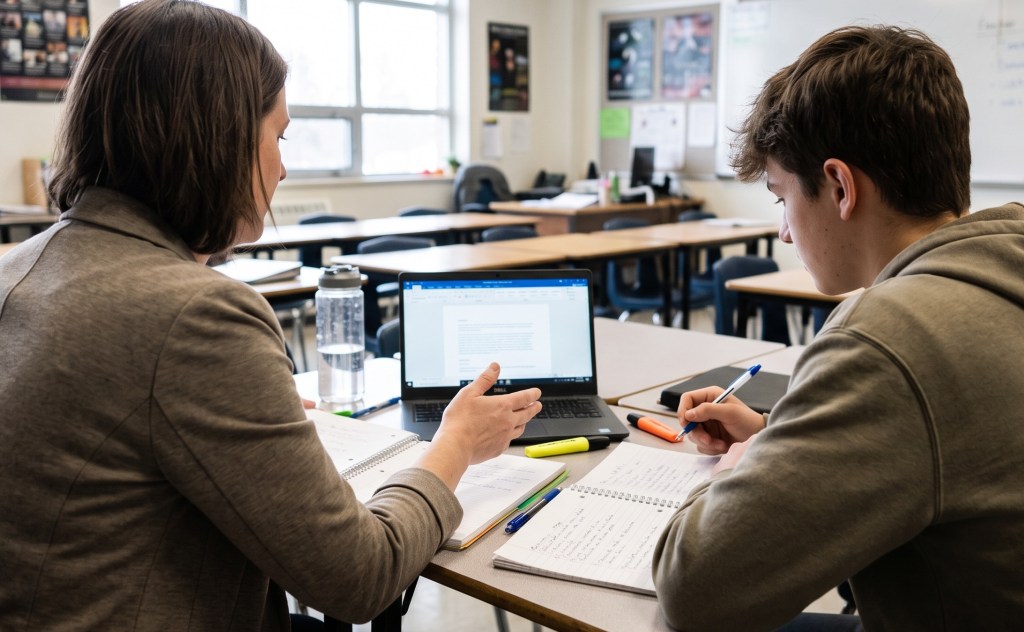
This week’s sources remind us that creating AI policies isn’t the same as getting your school ready for AI.
New research from Harvard finds that worries about AI cheating are hurting trust between teachers and students. And a new survey of independent school Heads by SAIS shows that school leaders are further along with AI than their faculty. Together, they raise two questions for independent schools:
Are our teachers ready to make good decisions about AI in their classrooms? And how is the way we handle AI affecting trust between teachers and students?
I think that second question matters most. Close relationships between teachers and students are a big part of why families choose independent schools, and thus goes straight to our value proposition.
Let’s look at the sources…
1. “An AI Policy Isn’t a Playbook” | Harvard Graduate School of Education, Center for Digital Thriving | Tench, Weinstein, James, et al. | September 30, 2026
Researchers surveyed more than 1,000 public school teachers and principals nationally and interviewed educators and teens. Among educators who had faced a difficult decision involving AI, most said it was about cheating: 74% of teachers and 69% of principals. The researchers describe “two-way suspicion.” Teachers develop what the researchers call “AI-dar,” a hunch that a student used AI that they can’t prove. Students, meanwhile, worry about being falsely accused. Some said they turn in weaker work on purpose so it won’t look AI-generated. The result is a lost connection: the things teachers rely on to know a student, like their writing voice and the questions they ask over time, start to disappear.
Takeaway: Academic integrity in the age of AI is a trust problem, not just a rules problem. A school that leans mostly on AI detection software and monitoring can turn teachers into referees instead of coaches. A better approach is to redesign assignments so students show their thinking along the way, talk openly with students about when and how AI may be used, and involve teachers in writing the policy. The research also found that some teachers feel boxed in by their school’s AI rules, whether those rules push AI or restrict it. This data comes from public schools, but the stakes are higher for us, because strong teacher-student relationships are central to what independent schools offer.
Read the report: https://digitalthriving.gse.harvard.edu/an-ai-policy-isnt-a-playbook/
Read Harvard’s summary: https://www.gse.harvard.edu/ideas/usable-knowledge/26/10/ai-cheating-crisis-schools-isnt-only-what-you-think
2. “October 2026 Signals” | Southern Association of Independent Schools (SAIS) | Brett Jacobsen | October 2026
SAIS surveyed Heads at its member schools about hiring, retention and AI. On AI, 81% of Heads say their faculty are still in the early “exploring” or “emerging” stages, and fewer than 2% say faculty AI use is “embedded and guided.” Administrative teams are further along: 23% are at the established or embedded stage, compared with 12.5% of faculty.
Takeaway: When leaders know more about AI than teachers do, decisions about AI in classrooms may get made by people who know its office uses better than its effects on learning. Heads should make sure to invest in teachers’ AI learning, and then ensure faculty have a real voice in decision-making about AI’s use for learning. Keep in mind that these are Heads’ impressions, SAIS hasn’t published its sample size, and its members are mostly in the South.
Read the report: https://sais.org/resource/october-2026-signals/
3. “K-12 AI Integration Trends” | Hanover Research | October 7, 2026
Hanover surveyed nearly 300 parents and educators in August. Among school staff, 67% want more AI training and support, only half say they’ve had enough time to teach students how to use AI well, and 41% say using AI effectively requires significant changes to how they teach.
Takeaway: Using AI well in the classroom will require teachers to put in time until they figure out how to use it best. Teachers need time to rethink assignments and assessment, not just training on tools. This will take time, and if faculty are expected to do that redesign on top of a full teaching load, AI will add to their workload rather than reduce it. I think Hanover’s research is applicable to our schools, but it’s worth noting that the study’s sample is small, designed with a Michigan superintendents’ association, and doesn’t say what kinds of schools respondents came from. Again, I think it’s applicable.
Read the report: https://www.hanoverresearch.com/reports-and-briefs/k-12-education/k-12-ai-integration-trends/
Mike Gwaltney is a long-time independent school educator and former Head of School. He is Vice President of Consulting and Learning, and a Senior Consultant at Independent School Management (ISM). Mike has been at the forefront of academic technology since the early 2000s and is widely considered the “OG” of blended and online learning in independent schools. He holds a Master’s in Educational Technology, and writes about student agency, teaching and learning, and leadership and governance of AI in independent schools.


Leave a Reply