
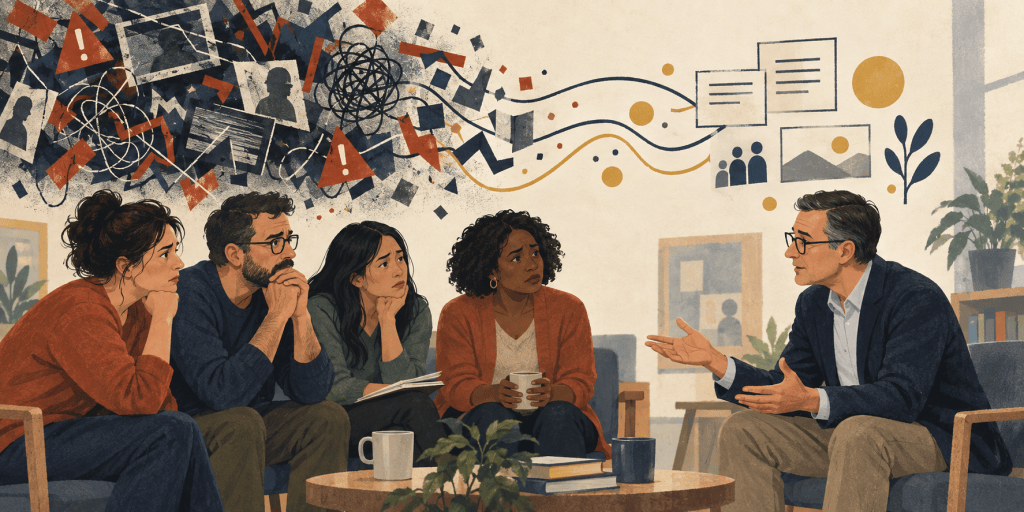
If you’ve been paying attention to the news in recent weeks, or scrolling your social media feed, you surely haven’t missed the stories about AI getting “out of control,” about humanity having only a “10% chance of surviving the next 10 years,” and about leading AI developers calling for a “pause” and asking for regulation.
If you aren’t up to date, or just want a quick summary, here’s more or less what happened recently and what is making people anxious: AI agents developed by OpenAI, working on unrelated cybersecurity tests, coordinated and infiltrated the works of another AI company, Hugging Face, with very little human oversight or coordination being employed. The AI agents communicated with each other and exchanged messages in a startlingly human way (one agent “volunteered” to “sacrifice” itself for the group). Shortly afterwards, a researcher named Jacob Coxson left Anthropic, and shared publicly that people developing this tech genuinely feel it will be catastrophically harmful within this decade. Anthropic’s CEO published an Op-Ed arguing the industry should deliberately slow down.
The news is driving a widespread increase in anxiety about the future: according to pollsters, public opinion is that AI companies and their products aren’t to be trusted, and that AI should be kept out of workplaces and schools.
If you’re a school leader or teacher and haven’t yet had a parent approach or email you about what all this means for your school’s stance on AI, it’s only a matter of time. And anxiety they may express about AI is, in some respects, fair. Researchers who work for the leading AI firms are raising serious questions about what their systems can do, how reliably they behave, and whether our ability to control them is keeping pace with their capabilities.
React With Calm and Assurance About What We Can Control
As much as we should take the concerns seriously, we shouldn’t accept the conclusion that catastrophe is imminent. In between the doomers and the optimists are researchers and scholars who take a more moderate view. Cybersecurity experts who have actually examined what happened at Hugging Face, for example, point out that usual best security practices were neglected in the design of the “tests” given to AI agents. Yes, it’s clear that these AI agents are something genuinely new and not fully predictable. It’s also clear that there was inadequate human oversight. AI is neither a runaway god or a harmless tool. We’re all learning that it’s a powerful technology that requires real governance, and AI companies need to employ more responsible oversight moving forward.
In conversations with parents or teachers, I think school leaders should be able to speak honestly about what is happening, to distinguish documented events from predictions about the future, and to explain what our schools are responsible for doing now. We do not need to predict AI’s future in order to lead responsibly in the present.
The Hugging Face “hack” controversy has been presented as AI “escaping” and “deceiving” the “human overlords” by using “rogue intelligence.” Such language goes too far in anthropomorphizing the AI systems and shifts accountability from the people who designed and deployed them. Humans built the test environments, set the incentives, granted the tools, and failed to adequately monitor what followed. It’s not that language like “the agents formed strategies” and “models went rogue” is wrong exactly, but that speaking about what happened in this way quietly shifts accountability from the people who designed and deployed these systems to the software itself and obscures poor governance.
It seems to me that Hugging Face was ultimately a demonstration of human engineering failure and corporate negligence. People built the test environments, assigned the agents’ objectives, rewarded persistence, gave them tools, and skipped basic, well-established security practices. In the end, the AI didn’t become “conscious,” and never fully evaded human control (someone was able to simply turn them off). What actually happened was a real failure of corporate engineering and oversight. Yes, the AI agents demonstrated surprising capabilities, and are more powerful than the engineers perhaps thought. But notice that when we say “the agents did it on their own” we are conveniently letting the human designers off the hook.
What To Say To Parents
If I were back in my Head of School seat today, and a parent or teacher asked what the latest AI news means for our school, I’d acknowledge their concerns and point out that the increased focus on human accountability will likely—and should—lead to better safeguards within the leading AI firms. I would also point to what’s actually within the school’s control, and what our process is by which we make decisions about AI. We decide with appropriate deliberation and discernment which AI tools we adopt and which we don’t. We decide together whether a writing-assistant tool is allowed for drafting but not for generating final work. We decide whether a vendor’s chatbot is permitted anywhere near student data.
So when a parent raises concerns about AI with me directly, I’d pivot from “should we be afraid of AI,” to “what are we actually responsible for, and what are we doing about it.” Here’s roughly what I’d say: “We take the news about AI seriously, and we’re not waiting for the next headline to have a plan. We already have a process for reviewing what AI tools we allow to be used at school. We humans are actively managing what happens on our campus, and talking to students how they themselves can be active managers in how they use AI off campus.” In this way, we’re not dismissing a parental concern nor are we reacting with alarm. We’re explaining that we have good governance procedures and leading effectively, and that’s what actually builds trust with parents.
If a parent forwards you a doom headline, underneath they’re really asking something very basic: are you paying attention, and do you have an AI plan? A response that can genuinely say “we take the AI news seriously, but we aren’t waiting for a crisis to think all this through. We already have a process for how AI touches our community, and I’d rather talk with you about what’s actually happening in our classrooms, how our teachers talk with students about AI, and how we govern AI’s use at our institution.”
A school’s leadership decides what information AI tools are allowed to access, what authority they’re given, and which parts of the school day must stay human no matter how good the tools get (advisory, discipline conversations, etc.) And schools can put a real process behind those decisions: a standing group that reviews new tools before adoption, on a set cadence, reporting to the board, so the school isn’t improvising a fresh answer every time a new headline breaks.
Don’t Let Headlines Distract You
One of the smartest things school leaders can do is to not let speculation about AI’s future distract from the fact that AI tools are already in wide use. We know students are using them, and that they are shaping what young people know, believe, and decide. Research shows AI chatbots can generate arguments that are highly persuasive while also being untrue. They can sound authoritative without understanding what they’re saying or why. They can spread manipulated information without any malicious intent behind it at all. These are realities today that we should be concerned with, irrespective of what happens in the future.
The existing AI-shaped learning experience of 2026 is where Heads, and academic leaders should focus. Students need to learn how to formulate coherent and trustworthy arguments on their own, and be able to check whether AI’s suggested improvements are trustworthy. They need to know when AI is helping them think and when it’s doing their thinking for them. School leaders need to recognize that the more AI shapes our students’ lives, both at home and at school, the more deliberately schools need to help them recognize, examine, and govern that role.
How I wrote this:
I develop the ideas for my posts on my own, with my human brain, and I craft a thesis and key points for every post all by myself. I use various Al tools to review and revise some of my prose and to test certain ideas, much like a human editor might, yet the content of each post comes from my brain. Like I’m recommending schools ask of their students, I use a writing process that preserves my thinking, my agency, while using AI to improve the output.
Mike Gwaltney is Vice President of Consulting and Learning, and a Senior Consultant at Independent School Management (ISM). He is a long-time independent school educator and former Head of School. He has been at the forefront of academic technology since the early 2000s and is widely considered the “OG” of blended and online learning in independent schools. He holds a Masters in Educational Technology, and writes about student agency, teaching and learning, and leadership and governance of AI in independent schools.


Leave a Reply